SART Whole-Body Spinal Alignment, Chuna Therapy & International Patient Concierge
30+ Years Clinical Experience
en-US

Korean Medicine Guide
5 Signs Your Baby May Be Developing Pediatric Scoliosis
Learn 5 early signs of pediatric scoliosis in babies, including posture changes and spinal curves. Early detection helps ensure timely treatment.
Schedule a Consultation5 Signs Your Baby May Be Developing Pediatric Scoliosis
When your baby is born, every small movement feels precious. The way they curl their fingers, turn their head, or settle into sleep becomes something you naturally observe without effort. As parents, especially in the early months, you are often the first to notice when something feels slightly off—even before a doctor does.
At Banpo Newborn Korean Medicine Clinic in Seoul, we’ve spent over 30 years working closely with infants, children, and families. One thing we’ve learned through both clinical experience and countless conversations with parents is this: early spinal changes rarely announce themselves loudly. They whisper. And pediatric scoliosis is no exception.
To be honest, many people think scoliosis only appears in teenagers. In reality, pediatric and infant scoliosis can begin far earlier, sometimes within the first year of life. The good news is that when detected early, the spine is highly adaptable, and gentle, non-invasive care can make a meaningful difference.
Below are five early signs that may suggest your baby is developing pediatric scoliosis—and what you can do if you notice them.
Understanding Pediatric Scoliosis in Babies
Before diving into the signs, it helps to understand what pediatric scoliosis actually is.
Pediatric scoliosis refers to an abnormal sideways curvature of the spine that develops during infancy or early childhood. In babies, it is often categorized as:
Infantile scoliosis (0–3 years)
Early-onset scoliosis (before age 10)
Unlike adolescent scoliosis, which often progresses rapidly during growth spurts, infant scoliosis can be subtle at first. The spine of a baby is soft, flexible, and still forming. This means early imbalances—if left unaddressed—can influence how the spine grows over time.
Dr. Ungjin Im often explains it this way:
“A baby’s spine is like wet clay. Small pressures, repeated over time, can shape it—either toward balance or imbalance.”
Sign 1: Persistent Head Tilt or Preference to One Side
One of the earliest signs parents notice is that their baby consistently tilts their head to one side or prefers looking in one direction.
At first glance, this may seem harmless. Many babies develop a side preference due to their position in the womb or how they sleep. However, when the head tilt is persistent and does not improve over time, it may indicate underlying spinal or muscular imbalance.
Why this matters
The cervical spine (neck) and thoracic spine (upper back) are closely connected. If the neck muscles are tight on one side, the spine may begin compensating below, creating a gentle curve.
In Korean medicine, we view this as an issue of structural harmony. When one area is restricted, the body adapts elsewhere.
What parents often say
“My baby always looks to the right, no matter how I place them.”
“Even when sleeping, their head turns back to the same side.”
“One side of the neck feels tighter when I pick them up.”
If this pattern continues beyond a few weeks, especially after tummy time and gentle stretching, it’s worth having your baby’s spine assessed.
Sign 2: Uneven Shoulders, Ribs, or Waistline (Even Subtle Ones)

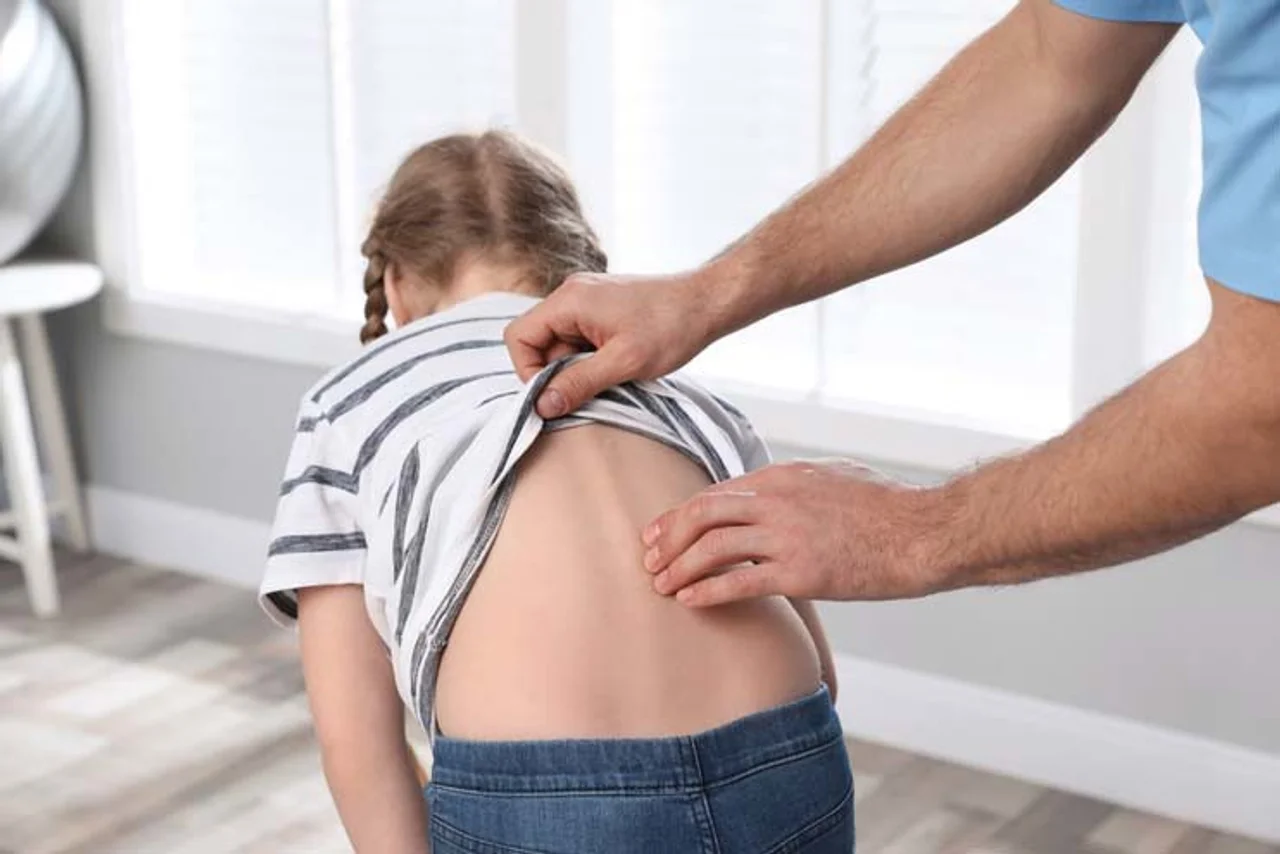
In babies, scoliosis does not usually present as a dramatic curve. Instead, it shows up as small asymmetries.
You may notice:
One shoulder sitting slightly higher
One side of the ribcage appearing more prominent when the baby is lying down
A subtle curve in the body when viewed from above
The waist or torso looking uneven during diaper changes
Parents often dismiss these signs because babies naturally move and squirm. But consistent asymmetry—especially when the baby is relaxed—is something we take seriously.
A clinical insight from Banpo Newborn
During our spinal assessments, we gently observe how a baby’s spine aligns when gravity is minimized. Even mild asymmetry can indicate rotational tension in the vertebrae, which may progress as the child grows.
Early detection allows us to guide spinal development before the curve becomes structural.
Sign 3: One-Sided Movement or Uneven Use of Arms and Legs
Babies should gradually develop balanced movement—reaching, rolling, kicking, and pushing symmetrically.
A potential warning sign is when your baby:
Rolls only in one direction
Uses one arm more actively than the other
Pushes more strongly with one leg
Appears weaker or less coordinated on one side
This doesn’t necessarily mean neurological damage. Often, it reflects postural imbalance rooted in the spine or pelvis.
Why movement patterns matter
The spine is the central axis of movement. If it’s slightly misaligned, the nervous system adapts by favoring one side. Over time, this creates a feedback loop: imbalance leads to compensation, and compensation reinforces imbalance.
From a holistic Korean medicine perspective, we look not only at bones, but also at how energy, nerves, and muscles communicate through the spine.
Sign 4: Flattening or Asymmetry in the Head and Upper Back
Many parents are familiar with positional plagiocephaly (flat head syndrome). What is less known is that head shape asymmetry and spinal alignment are deeply connected.
If your baby has:
A flat spot on one side of the head
Uneven ear alignment
Asymmetry extending from the head into the shoulders or upper back
…it may suggest that the spine is under uneven pressure.
A common misconception
Some parents believe helmet therapy alone will resolve the issue. While helmets can help reshape the skull, they do not address the underlying spinal or muscular imbalance that caused the asymmetry in the first place.
At Banpo Newborn, we often work collaboratively with families to ensure that head shape correction goes hand-in-hand with gentle spinal alignment, supporting whole-body balance.
Sign 5: Delays or Awkwardness in Developmental Milestones
Every baby develops at their own pace. However, certain patterns may indicate that the spine is affecting motor development.
Watch for:
Difficulty sitting upright without leaning
Arching the back excessively
Discomfort during tummy time
Fussiness when held in certain positions
Avoidance of crawling or asymmetric crawling patterns
These behaviors can reflect discomfort or instability in the spine, even if the baby cannot express it verbally.
One parent once told us:
“I thought my baby just hated tummy time. I didn’t realize her spine was making it uncomfortable.”
After gentle spinal correction, tummy time became easier—and developmental progress followed naturally.
Why Early Detection Is So Important
The spine grows rapidly in the first few years of life. During this time, small corrections can have a big impact.
If pediatric scoliosis is left unaddressed, it may:
Progress as the child grows
Affect posture, balance, and gait
Place strain on the nervous system
Contribute to chronic pain later in life
The goal is not to label or alarm, but to support healthy growth.
Dr. Im often reminds parents:
“We’re not treating a curve—we’re guiding development.”
How Banpo Newborn Approaches Pediatric Scoliosis

Our approach is deeply rooted in Korean medicine, modern biomechanics, and decades of hands-on experience.
1. Gentle, Non-Invasive Assessment
We use careful observation, palpation, and movement analysis—never forceful manipulation. Babies are assessed in a calm, parent-present environment.
2. Spinal Alignment Restoration Therapy (SART)
SART focuses on restoring spatial balance of the spine, not just straightening it. For infants, this involves extremely gentle techniques designed to guide natural alignment.
3. Whole-Body Perspective
We consider:
Birth history
Sleeping positions
Feeding posture
Developmental patterns
Muscle tone and symmetry
Everything is connected.
4. Parent Education and Home Guidance
We believe parents are active partners in healing. Simple positioning tips, holding techniques, and daily habits can reinforce clinical care.
When Should You Seek a Professional Evaluation?
Consider seeking an evaluation if:
You notice two or more of the signs mentioned above
Asymmetry persists beyond a few weeks
Your intuition tells you something isn’t quite right
You don’t need to wait for symptoms to worsen. Early consultation is about peace of mind as much as prevention.
A Final Word to Parents
If you’ve been carefully watching your baby and wondering whether you’re overthinking—please know this: your attention matters.
Many parents who visit Banpo Newborn say the same thing:
“I felt something was off, but I didn’t know who to ask.”
You’re not alone, and you’re not imagining things. Pediatric scoliosis doesn’t always look dramatic, but early signs are there for those who know how to see them.
With timely, gentle care, the growing spine can be guided toward balance—supporting not just posture, but comfort, development, and long-term health.
If you’re considering a spinal check-up for your baby, Banpo Newborn Korean Medicine Clinic offers comprehensive pediatric evaluations rooted in compassion, precision, and over three decades of experience.
Because when it comes to your child’s spine, early care isn’t aggressive—it’s thoughtful.
More Medical Articles
Continue reading clinical insights from Banpo Newborn Korean Medicine Clinic.

Why Seoul is the Global Hub for Minimally Invasive Vertigo Treatment
Dizziness and vertigo are among the most common reasons for hospital visits in South Korea, affecting nearly 16.7% of the adult population annually according to the Korea National Health and Nutrition Examination Survey (KNHANES).
Learn More

Tinnitus Relief in Seoul: Multidisciplinary Upper Cervical Care
For many, the sound of silence is replaced by a persistent ringing, buzzing, or hissing. In South Korea, this is more than an individual annoyance; it is a significant public health trend.
Learn More

Success Rates of SART for OPLL Compared to Standard Laminectomy in Korea
The prevalence of Ossification of the Posterior Longitudinal Ligament (OPLL) in East Asian populations, particularly in South Korea, is significantly higher than in Western countries, affecting approximately 2% to 4% of the population according to nationwide...
Learn More