SART Whole-Body Spinal Alignment, Chuna Therapy & International Patient Concierge
30+ Years Clinical Experience
en-US


Korean Medicine Guide
Don’t Wait to Treat Infant Torticollis — Why Early Intervention Matters
Early infant torticollis treatment prevents long-term issues. Learn why early intervention matters and how to support healthy neck development.
Schedule a ConsultationDon’t Wait to Treat Infant Torticollis — Why Early Intervention Matters

If you’re a new parent, you probably spend a lot of time watching your baby sleep, stretch, or simply explore the world with those curious eyes. But one day, you may notice something subtle — your baby seems to prefer turning their head to one side or consistently tilts their neck in one direction. For many parents in Korea and around the world, this becomes the first sign of infant torticollis.
At Banpo Newborn Korean Medicine Clinic, we meet countless families who come in with the same question: “Is it okay to wait and see if it gets better on its own?”
To be honest, this is one of the few conditions where we encourage parents not to take a wait-and-see approach. Early intervention is not just ideal — it is transformative.
Infant torticollis is highly treatable, especially in the early months of life. But when treatment is delayed, it can influence a child’s posture, facial symmetry, motor development, and even long-term spinal balance. Understanding why early care matters can make a meaningful difference in your child’s growth.
As a clinic that has supported families for more than 30 years through specialized spinal and musculoskeletal care, we want to share not only the medical reasons behind early treatment but also the heartfelt stories and insights that guide our work every day.
What Is Infant Torticollis? A Simple Explanation for Parents
Infant torticollis — known as 사경증 in Korean — occurs when a baby’s neck muscles tighten asymmetrically, causing the head to tilt to one side and rotate to the opposite side.
There are two primary types:
1. Congenital Muscular Torticollis (CMT)
This is present at birth and can be related to:
Tightening or shortening of the sternocleidomastoid (SCM) muscle
In-utero positioning
Birth trauma or difficult delivery
Limited space in the womb (especially with twins)
2. Acquired Torticollis
This appears after birth and may be linked to:
Preferred sleeping positions
Neck muscle imbalance
Visual or neurological issues (less common)
Most cases are congenital and respond exceptionally well to early therapeutic intervention — especially within the first three to six months, when a baby’s muscles are rapidly developing and most adaptable.
Why You Shouldn’t “Wait and See”: The Hidden Impact of Delayed Treatment

Many parents delay treatment simply because torticollis doesn’t seem painful. The baby smiles, feeds, and sleeps — so it feels harmless. But here is the truth we often share gently with parents:
Torticollis is not just a neck issue. It is a whole-body developmental issue.
1. Delayed Motor Development
Babies with torticollis often struggle with:
Rolling evenly to both sides
Lifting the head during tummy time
Crawling symmetrically
As Dr. Ungjin Im often says, “The neck is the steering wheel of the body — when it’s off-center, the entire body compensates.”
2. Facial and Cranial Asymmetry (Plagiocephaly)
A constant head tilt or preference leads to uneven pressure on the skull, especially during the first months when bones are soft and moldable.
Untreated torticollis is one of the strongest predictors of plagiocephaly, which can become harder to correct as the skull bones gradually fuse.
3. Compensatory Spinal Curvature
When the neck tilts consistently, the spine adapts over time:
Mild scoliosis-like curves may develop
Pelvic imbalance can emerge
Postural asymmetry persists into later childhood
As a clinic specializing in early spinal alignment, we’ve observed that even a slight persistent head tilt in infancy can influence the child’s entire musculoskeletal pattern.
4. Feeding and Digestive Challenges
Babies with torticollis may:
Prefer one breast
Have difficulty maintaining latch
Experience increased fussiness or reflux due to feeding posture
5. Long-Term Posture and Coordination Issues
Children who had untreated torticollis often show:
Head-tilt habits
Coordination differences between sides
Challenges in sports or balance activities
When early intervention is missed, treatment later becomes more complex, requiring longer therapy and sometimes involving compensatory issues down the line.
Why Early Treatment Works So Well: The Science Behind It
Infants, especially newborns, have highly adaptable muscles and connective tissues. Their motor patterns are still forming, and spinal alignment is incredibly responsive.
In the first six months:
Muscle fibers are still lengthening
The nervous system is rapidly wiring movement patterns
Skull bones remain flexible
Posture habits are not yet fixed
This is why early intervention often leads to fast, gentle, and lasting results.
Once babies begin sitting, standing, and walking, compensatory postures become more reinforced — making correction more complex.
To put it simply:
The earlier we treat torticollis, the less the body has adapted to the imbalance.
How Banpo Newborn Korean Medicine Clinic Approaches Infant Torticollis
For more than 30 years, our clinic has taken a specialized approach to musculoskeletal imbalance — one that emphasizes precision, gentleness, and respect for the child’s developing body.
Our method integrates traditional Korean medicine principles with modern pediatric biomechanics.
1. Comprehensive Diagnostic Assessment
We evaluate:
Head tilt degree
Cervical range of motion
Facial symmetry
Cranial shaping patterns
Spinal balance
Hip and pelvic alignment
Motor development milestones
Many parents are surprised to learn how interconnected these factors are. A slight head rotation often links to pelvic tilt or asymmetric crawling patterns.
2. Spatial Spinal Assessment for Infants
While infants do not require spinal correction in the same way adults do, our clinic uses a unique spatial assessment — originally developed for adult spinal alignment — adapted for babies.
This helps us see how the neck imbalance influences the whole body.
3. Gentle Korean Medicine Manual Therapy
Our pediatric manual techniques are extremely soft and tailored to the infant’s comfort level. We focus on:
Releasing tight SCM or upper cervical muscles
Supporting mobility on the weaker side
Encouraging balanced head-turning patterns
Improving symmetry in shoulder and pelvic alignment
Many parents describe the treatment as “massage-like,” though it is far more precise in intent.
4. SART Principles Applied to Infant Care
Although Spinal Alignment Restoration Therapy (SART) is typically used for older patients, some principles apply to infant torticollis:
Restoring natural alignment
Releasing areas under strain
Encouraging balanced neurological input
Dr. Im’s insight has always been that early alignment allows the child’s growth to occur in the most harmonious way possible.
5. At-Home Guidance for Parents
We provide personalized guidance on:
Tummy time strategies
Feeding positions
Play patterns that encourage symmetrical movement
Environmental setups that reduce positional bias
Parents often tell us they feel empowered after learning how small daily habits accelerate healing.
A Real Story from Our Clinic (Shared With Permission)
One mother brought her 2-month-old son to us, worried about a persistent head tilt and flatness on one side of the head. She had been told to “wait and see,” but something in her heart didn’t feel right.
During the first evaluation, we found:
Limited rotation on one side
Early asymmetry in facial muscles
Tension extending from the neck to the hip
After just a few sessions of gentle manual therapy and guided at-home exercises, the baby’s head tilt improved significantly. By 4 months, his head shape had become more symmetrical, and by 6 months, he was hitting motor milestones evenly.
The mother later told us, “I’m so grateful I didn’t wait. I feel like I gave him the best start possible.”
This is why we are so passionate about early intervention — we’ve seen time and time again how much easier and more natural healing becomes when we address torticollis early.
What Happens if You Start Treatment After 6 Months?
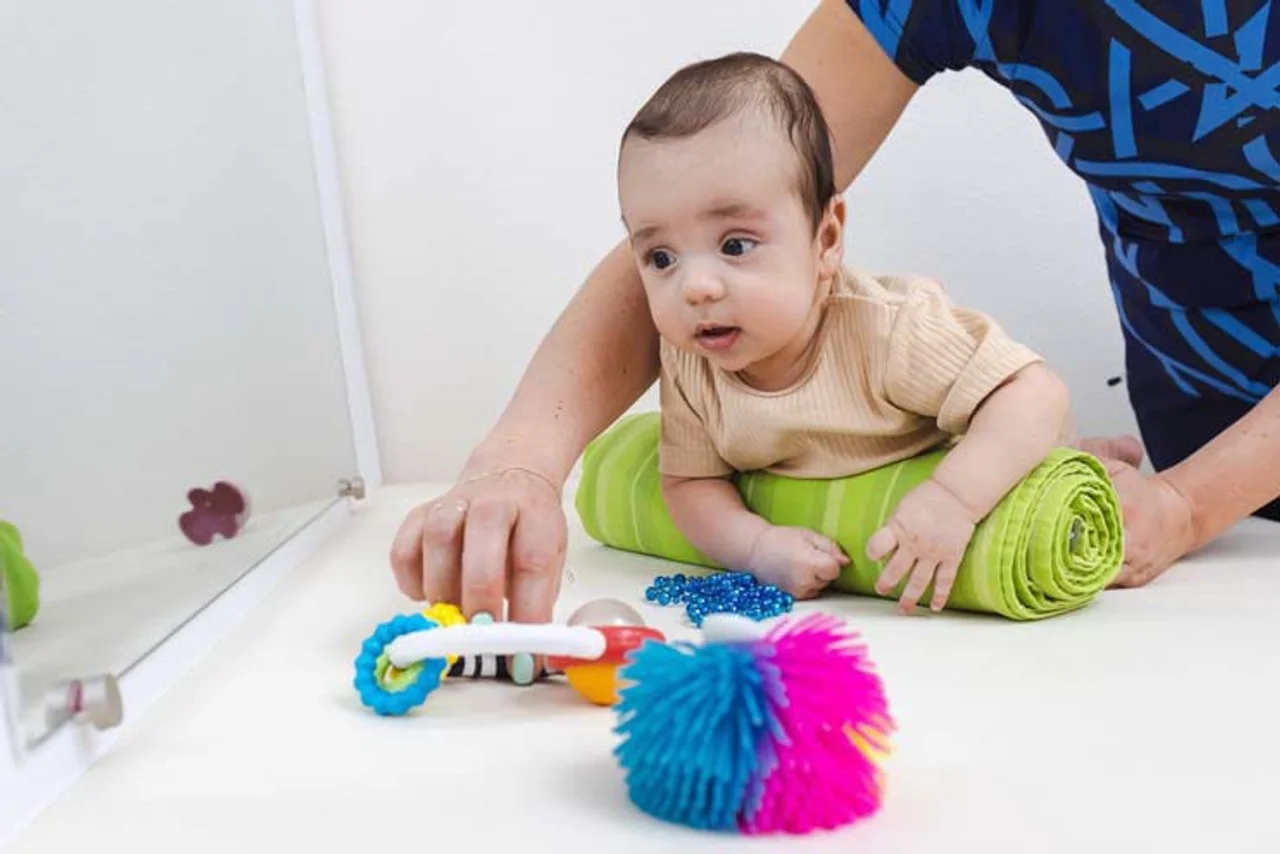
Treatment is still effective — but it usually requires:
More sessions
Greater focus on compensatory patterns
Additional support for motor development
Cranial asymmetry is harder to correct after 6 months, and the spine begins establishing more permanent posture habits.
The good news is that with consistent care, most infants still show excellent outcomes — but we always encourage parents to come earlier when possible.
How to Tell If Your Baby Might Have Torticollis
Here are some common signs parents notice:
Tilts the head consistently to one side
Prefers looking in one direction
Cries when turning one way but not the other
Difficulty breastfeeding on one side
Flattening on the back or one side of the head
Uneven shoulders
Uses one hand more than the other
Trouble with tummy-time lifting
If you notice any of these, it is worth seeking an evaluation — even if your baby seems otherwise content.
When Should Parents Seek Help?
We recommend seeking evaluation:
As early as 2–3 weeks old if you notice early signs
Immediately if the head tilt persists beyond 1–2 weeks
By 2 months, even if the signs seem mild
Anytime, if you feel something seems “off”
Parents often underestimate how early torticollis can be detected — and how early it can be corrected.
More Medical Articles
Continue reading clinical insights from Banpo Newborn Korean Medicine Clinic.

Why Seoul is the Global Hub for Minimally Invasive Vertigo Treatment
Dizziness and vertigo are among the most common reasons for hospital visits in South Korea, affecting nearly 16.7% of the adult population annually according to the Korea National Health and Nutrition Examination Survey (KNHANES).
Learn More

Tinnitus Relief in Seoul: Multidisciplinary Upper Cervical Care
For many, the sound of silence is replaced by a persistent ringing, buzzing, or hissing. In South Korea, this is more than an individual annoyance; it is a significant public health trend.
Learn More

Success Rates of SART for OPLL Compared to Standard Laminectomy in Korea
The prevalence of Ossification of the Posterior Longitudinal Ligament (OPLL) in East Asian populations, particularly in South Korea, is significantly higher than in Western countries, affecting approximately 2% to 4% of the population according to nationwide...
Learn More