SART Whole-Body Spinal Alignment, Chuna Therapy & International Patient Concierge
30+ Years Clinical Experience
en-US


Korean Medicine Guide
Frozen Shoulder and TMJ Disorder: Treating the Whole Body
Frozen shoulder and TMJ disorder explained through a whole-body approach, covering causes, symptoms, and integrative treatment options.
Schedule a ConsultationFrozen Shoulder and TMJ Disorder: Treating the Whole Body, Not Just the Pain

Have you ever noticed how pain rarely exists in isolation?
A shoulder that won’t lift, a jaw that clicks or aches, tension that creeps up the neck and settles behind the eyes. Many patients come to our clinic convinced they have two separate problems: frozen shoulder on one side of the body, and a TMJ disorder on the other. They’ve seen orthopedists for the shoulder, dentists for the jaw, and physical therapists for the neck—yet the pain persists.
To be honest, this is one of the most common misunderstandings we see in modern musculoskeletal care.
At Banpo Newborn Korean Medicine Clinic, we’ve learned through decades of hands-on experience that frozen shoulder and TMJ disorder are often not separate conditions at all. They are frequently expressions of the same underlying imbalance—a whole-body misalignment rooted in the spine, posture, and nervous system.
This article explores why frozen shoulder and TMJ disorder are deeply connected, why treating them separately often fails, and how a whole-body, non-invasive approach can restore lasting balance and relief.
Understanding Frozen Shoulder Beyond the Shoulder Joint
Frozen shoulder, medically known as adhesive capsulitis, is often described as inflammation or stiffness of the shoulder capsule. But that definition barely scratches the surface.
What Patients Actually Experience
Patients don’t just complain of pain. They describe:
Inability to raise the arm overhead
Difficulty reaching behind the back
Pain that worsens at night
A feeling that the shoulder is “locked” or “stuck”
Over time, many patients adapt their posture subconsciously—tilting the head, lifting one shoulder higher, or rotating the upper body to compensate. This is where the problem quietly spreads.
The Hidden Cause: Loss of Upper Body Coordination
In our clinical experience, frozen shoulder is rarely just a shoulder problem. It is often the result of:
Cervical (neck) misalignment
Thoracic spine rigidity
Asymmetrical scapular movement
Chronic postural imbalance
When the spine loses its natural alignment, the shoulder joint becomes a victim of restricted movement patterns. Over time, inflammation and stiffness set in—not because the shoulder is weak, but because it is overloaded and misused.
TMJ Disorder: A Jaw Problem That Starts Much Lower
TMJ disorder is frequently treated as a dental or jaw-specific issue. Mouth guards, bite adjustments, or even surgery are often suggested. While these may help some patients, many continue to suffer from:
Jaw pain or clicking
Facial asymmetry
Headaches or migraines
Neck and shoulder tension
Ear fullness or tinnitus
The Jaw Is a Postural Joint
What many people don’t realize is that the temporomandibular joint (TMJ) does not function independently. It is neurologically and mechanically linked to:
The upper cervical spine
The shoulder girdle
The pelvic balance of the body
When posture collapses—especially forward head posture or spinal rotation—the jaw compensates. Over time, this compensation leads to muscular imbalance, disc displacement, and chronic TMJ dysfunction.
Why Frozen Shoulder and TMJ Disorder Often Appear Together
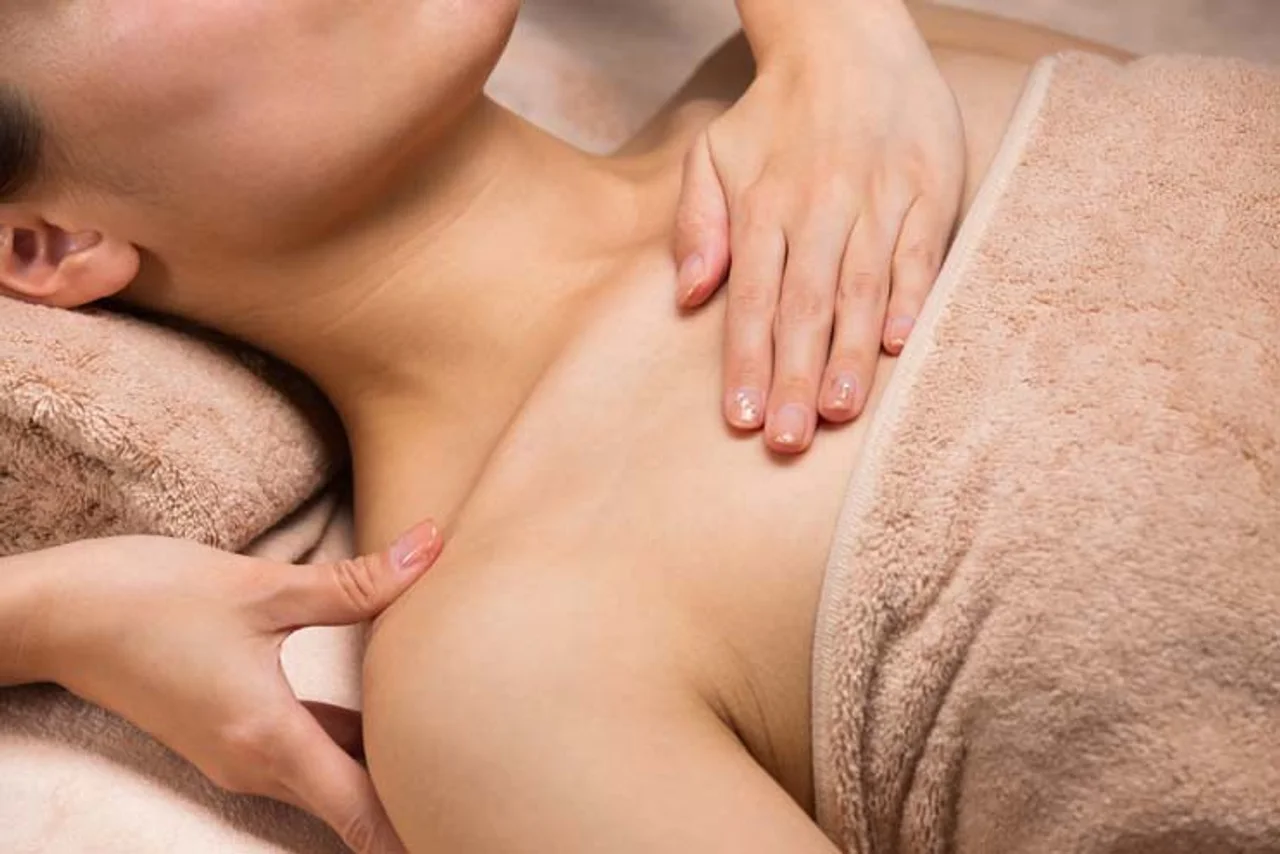
In clinical practice, we often see patients who develop frozen shoulder on one side and TMJ symptoms on the opposite side. This pattern is not random.
The Spiral Pattern of Compensation
The human body operates as a connected kinetic chain. When spinal alignment is lost, the body adapts in a spiral pattern:
One shoulder elevates or rotates forward
The head tilts or shifts laterally
The jaw deviates to maintain balance
Muscles tighten asymmetrically
Over months or years, these compensations harden into chronic conditions—frozen shoulder in one region, TMJ disorder in another.
From this perspective, treating only the shoulder or only the jaw is like repainting cracked walls without fixing the foundation of the house.
Why Localized Treatments Often Fail
Many patients arrive at our clinic after trying:
Cortisone injections for frozen shoulder
Physical therapy focused only on the arm
Dental splints for TMJ
Pain medication or muscle relaxants
While these approaches may temporarily reduce symptoms, they often fail to deliver lasting relief. Why?
Because the root cause remains untouched.
Inflammation is not the cause—it is the result. Pain is not the disease—it is the signal. Until spinal alignment, postural balance, and neuromuscular coordination are restored, symptoms will continue to shift from one area to another.
A Whole-Body Perspective: The Korean Medicine Approach
Traditional Korean medicine has always viewed the body as an interconnected system. At Banpo Newborn, this philosophy is combined with modern anatomical precision and decades of clinical refinement.
Spinal Alignment Restoration Therapy (SART)
Developed through Dr. Ungjin Im’s extensive clinical experience, SART focuses on restoring the body’s natural spatial alignment rather than forcing joints into place.
Key principles include:
Non-invasive, precise spinal correction
Gentle normalization of cervical and thoracic alignment
Restoring symmetrical load distribution
Re-educating the nervous system’s movement patterns
When spinal alignment improves, the shoulder regains mobility without aggressive stretching, and the jaw often relaxes naturally.
Treating Frozen Shoulder Through the Spine
Instead of forcing shoulder mobility, our approach begins with:
Cervical spine balance to reduce nerve irritation
Thoracic mobility restoration to allow natural shoulder mechanics
Scapular alignment to relieve joint stress
As posture improves, inflammation decreases organically. Many patients are surprised to find that shoulder range of motion returns without painful manipulation.
One patient once told us, “I came in because my shoulder wouldn’t move. I didn’t expect my neck and posture to be the answer.”
TMJ Recovery Through Structural Balance
Similarly, TMJ disorder often improves when:
The head is no longer pulled forward
Neck muscles release their chronic tension
Shoulder height becomes symmetrical
Pelvic balance stabilizes posture
By correcting spinal alignment, we reduce abnormal jaw loading without forcing the bite or relying solely on dental appliances.
This whole-body approach respects the jaw as part of a larger postural system—not an isolated hinge.
The Emotional Toll of Chronic Pain—and Why It Matters
Living with frozen shoulder or TMJ disorder is exhausting. Patients often describe:
Sleep disruption
Irritability
Anxiety about movement
Fear of permanent damage
When pain persists despite multiple treatments, it can feel hopeless.
At Banpo Newborn, we believe healing must address not only the physical structure, but also the emotional burden of chronic pain. Our one-on-one care model allows us to listen carefully, adjust treatment gradually, and support patients through the recovery process with patience and clarity.
Real Recovery Takes Time—but It Is Possible
Frozen shoulder and TMJ disorder do not develop overnight, and they do not resolve instantly. But when treatment addresses the true cause, progress becomes steady and sustainable.
Patients often notice:
Improved sleep within weeks
Reduced jaw tension and clicking
Gradual return of shoulder mobility
A sense of balance returning to the body
Perhaps most importantly, they regain confidence in movement—without fear.
When Should You Consider a Whole-Body Evaluation?
You may benefit from a comprehensive spinal and postural assessment if:
Frozen shoulder has not improved with conventional treatment
TMJ symptoms persist despite dental care
Neck stiffness accompanies either condition
Pain seems to “move” around the body
You feel asymmetrical when standing or walking
A thorough evaluation can reveal imbalances that are easy to miss but critical to long-term healing.
A Final Thought from Banpo Newborn Korean Medicine Clinic
If there is one lesson decades of clinical practice have taught us, it is this:
The body never breaks down in pieces—it adapts as a whole.
Frozen shoulder and TMJ disorder are not separate battles. They are signals calling for a more integrated, respectful approach to healing.
If you’ve been living with chronic pain and feel stuck, you’re not alone. With the right perspective, gentle precision, and whole-body care, recovery is not only possible—it is achievable.
Considering a spinal and postural evaluation?
Banpo Newborn Korean Medicine Clinic in Banpo, Seoul offers personalized, non-invasive care grounded in experience, compassion, and structural precision—for those seeking lasting solutions, not temporary relief.
More Medical Articles
Continue reading clinical insights from Banpo Newborn Korean Medicine Clinic.

Why Seoul is the Global Hub for Minimally Invasive Vertigo Treatment
Dizziness and vertigo are among the most common reasons for hospital visits in South Korea, affecting nearly 16.7% of the adult population annually according to the Korea National Health and Nutrition Examination Survey (KNHANES).
Learn More

Tinnitus Relief in Seoul: Multidisciplinary Upper Cervical Care
For many, the sound of silence is replaced by a persistent ringing, buzzing, or hissing. In South Korea, this is more than an individual annoyance; it is a significant public health trend.
Learn More

Success Rates of SART for OPLL Compared to Standard Laminectomy in Korea
The prevalence of Ossification of the Posterior Longitudinal Ligament (OPLL) in East Asian populations, particularly in South Korea, is significantly higher than in Western countries, affecting approximately 2% to 4% of the population according to nationwide...
Learn More