SART Whole-Body Spinal Alignment, Chuna Therapy & International Patient Concierge
30+ Years Clinical Experience
en-US


Korean Medicine Guide
How to Keep Your Spine Healthy in a Sedentary Job
Learn how to keep your spine healthy in a sedentary job with posture tips, desk ergonomics, daily stretches, and spine care strategies.
Schedule a ConsultationHow to Keep Your Spine Healthy in a Sedentary Job

A holistic, non-surgical perspective from Banpo Newborn Korean Medicine Clinic
If you work at a desk, you probably know this feeling all too well: your shoulders creep upward as the day goes on, your lower back feels tight by mid-afternoon, and by the time you get home, even resting doesn’t quite make the discomfort disappear. To be honest, many people assume this is just the “price” of a sedentary job. But after more than 30 years of caring for patients with chronic pain and postural imbalances at Banpo Newborn Korean Medicine Clinic, we can confidently say this: persistent spinal discomfort is not inevitable—and it is often preventable.
A sedentary job doesn’t just mean sitting. It usually means prolonged stillness, repetitive habits, and subtle postural stress that accumulates day after day. Over time, these small stresses can quietly alter spinal alignment, strain supporting muscles, and even affect the nervous system. The good news is that with the right understanding and consistent habits, you can protect your spine and restore balance—even if your job keeps you at a desk.
In this article, we’ll explore why sedentary work challenges spinal health, how those challenges affect the whole body, and what you can realistically do—starting today—to keep your spine healthy for the long term.
Why Sedentary Work Is Hard on the Spine
The spine was designed for movement, not stillness
From a Korean medicine perspective, the body thrives on circulation—of blood, energy (qi), and information through the nervous system. Sitting for long periods disrupts this natural flow. Anatomically, the human spine has gentle curves designed to absorb shock and distribute load during movement. When we sit for hours, especially with poor posture, those curves flatten or exaggerate unnaturally.
Think of your spine like the foundation of a house. If the foundation tilts even slightly, the walls, doors, and roof all begin to shift. In the body, that “tilt” may start as a minor pelvic imbalance or forward head posture—but over time, it can lead to neck pain, disc stress, headaches, jaw tension (TMJ issues), and even numbness in the arms or legs.
Common postural patterns in desk workers
In our clinic, we see recurring patterns among office workers in Seoul and beyond:
Forward head posture from leaning toward screens
Rounded shoulders from prolonged keyboard and mouse use
Compressed lower back from slouching or unsupported sitting
Uneven weight distribution from crossing legs habitually
These patterns don’t just strain muscles—they subtly change how the spine aligns in space. Dr. Ungjin Im often explains this as a “spatial imbalance,” where the spine no longer relates to gravity and movement in a healthy way.
How Spinal Imbalance Affects the Whole Body
One of the biggest misconceptions about back or neck pain is that it’s a local problem. In reality, the spine is the central highway of the nervous system, and even mild misalignments can have far-reaching effects.
Neck and shoulders: more than muscle tension
When the head shifts forward—even by a few centimeters—the neck muscles must work much harder to support its weight. This can lead to chronic stiffness, tension headaches, and reduced range of motion. Over time, cervical misalignment may also affect jaw mechanics, contributing to TMJ discomfort, teeth clenching, or facial asymmetry.
Lower back and pelvis: the silent stress zone
Sitting places sustained pressure on the lumbar spine and pelvis. If the pelvis tilts backward or rotates unevenly, the lumbar curve collapses. This is often when patients say, “My lower back just feels tired all the time.” Left unaddressed, this fatigue can progress to disc irritation, sciatica-like symptoms, or hip pain.
Fatigue, digestion, and even breathing
From a holistic standpoint, spinal health influences organ function and energy levels. A collapsed posture restricts diaphragmatic breathing, reducing oxygen intake and increasing fatigue. In Korean medicine, this can weaken overall vitality, making it harder for the body to recover from daily stress.
Building a Spine-Friendly Workday: Practical Foundations
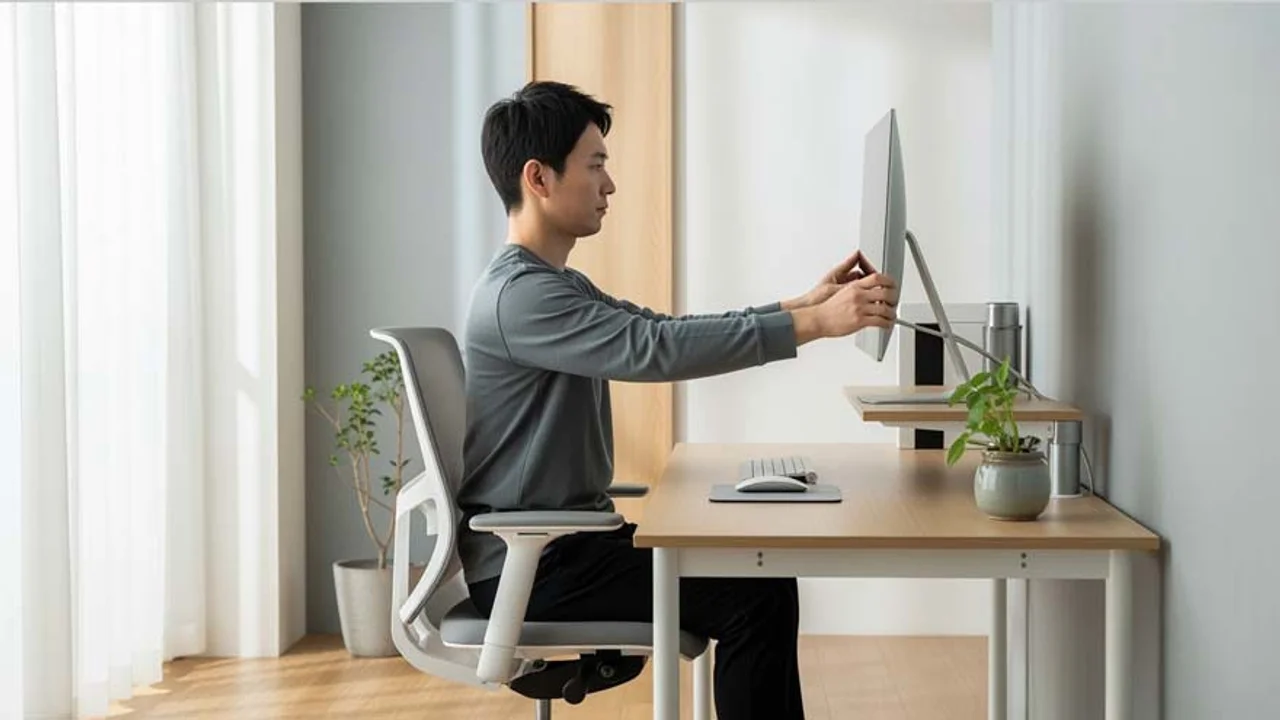
The key to spinal health in a sedentary job is not perfection—it’s consistency and awareness. Small adjustments, repeated daily, can make a profound difference.
1. Rethink how you sit (not just what chair you use)
A good chair helps, but posture matters more than price.
Sit with your feet flat on the floor, weight evenly distributed
Keep your pelvis neutral, not tucked under
Allow your lower back to maintain its natural curve (a small cushion can help)
Let your shoulders relax downward, not pulled back stiffly
Dr. Im often reminds patients: “Good posture should feel stable, not strained.” If you feel tense trying to sit “straight,” something is off.
2. Screen and desk alignment matters more than you think
Your screen should be at eye level, not pulling your head forward. The keyboard and mouse should allow your elbows to rest comfortably at your sides. These adjustments reduce the subconscious leaning that slowly distorts spinal alignment over time.
3. Break the stillness—frequently
One of the simplest but most powerful habits is movement.
Stand up or change position every 30–40 minutes
Gently stretch your neck, shoulders, and hips
Walk, even briefly, to reset circulation
In Korean medicine, movement prevents stagnation. Even one minute of conscious movement can interrupt hours of accumulated stress.
Daily Habits That Support Long-Term Spinal Health
Gentle spinal mobility exercises
You don’t need an intense workout at the office. Simple movements done regularly are enough:
Slow neck rotations within a pain-free range
Shoulder rolls to release tension
Seated spinal twists to encourage mobility
Standing back extensions to counter prolonged flexion
The goal is not force, but restoring natural motion.
Breathing as postural medicine
Shallow chest breathing often accompanies slouched posture. Try this: sit comfortably, place one hand on your lower ribs, and breathe deeply so the ribs expand outward. This supports spinal stability from the inside and calms the nervous system.
After-work recovery rituals
Many patients tell us they “collapse” on the sofa after work. While rest is important, gentle recovery is better:
Light walking
Warm showers to relax muscles
Stretching before bed
These habits help the spine reset instead of locking in the day’s stress.
When Self-Care Isn’t Enough: Knowing When to Seek Help

If you’ve been diligent with posture and movement but still experience:
Persistent neck or back pain
Radiating pain or numbness
Frequent headaches or jaw tension
A feeling that your body is “uneven”
…it may indicate deeper spinal misalignment.
At Banpo Newborn Korean Medicine Clinic, we often see patients who waited years, assuming their discomfort was normal. In reality, their bodies were compensating—until they could no longer keep up.
A non-surgical, whole-body approach
Our clinic specializes in Spinal Alignment Restoration Therapy (SART) and spatial spinal correction, developed through decades of clinical experience. Rather than forcing joints or focusing only on pain points, Dr. Im evaluates how the spine relates to the pelvis, head, and gravity as a whole.
Treatment is gentle, precise, and always personalized. Many patients are surprised to feel changes not only in pain levels, but also in posture awareness, breathing ease, and overall energy.
A Realistic Perspective: Progress, Not Perfection
If you’re reading this while sitting at a desk, you don’t need to overhaul your life overnight. Spinal health is built through small, repeatable choices. Adjust how you sit. Move a little more often. Pay attention to how your body feels instead of ignoring discomfort.
As we often tell our patients: Your spine is constantly communicating with you. Pain is not punishment—it’s information.
Listening early can save years of struggle later.
Final Thoughts: Your Spine Supports Your Life—Return the Favor
A sedentary job may be part of modern life, but chronic pain doesn’t have to be. With awareness, daily care, and professional guidance when needed, your spine can remain resilient, balanced, and supportive for decades to come.
If you’ve been living with discomfort and wondering whether it’s “too late,” we want you to know this: the body has an incredible capacity to recover when alignment and balance are restored. Healing is not about forcing change—it’s about guiding the body back to what it naturally knows.
If you’re considering a spinal check-up or want a more personalized assessment, Banpo Newborn Korean Medicine Clinic in Banpo, Seoul, offers comprehensive evaluations and one-on-one care rooted in experience, precision, and compassion. Your spine carries you through every day of your life. Taking care of it is not a luxury—it’s an investment in your future well-being.
More Medical Articles
Continue reading clinical insights from Banpo Newborn Korean Medicine Clinic.

Why Seoul is the Global Hub for Minimally Invasive Vertigo Treatment
Dizziness and vertigo are among the most common reasons for hospital visits in South Korea, affecting nearly 16.7% of the adult population annually according to the Korea National Health and Nutrition Examination Survey (KNHANES).
Learn More

Tinnitus Relief in Seoul: Multidisciplinary Upper Cervical Care
For many, the sound of silence is replaced by a persistent ringing, buzzing, or hissing. In South Korea, this is more than an individual annoyance; it is a significant public health trend.
Learn More

Success Rates of SART for OPLL Compared to Standard Laminectomy in Korea
The prevalence of Ossification of the Posterior Longitudinal Ligament (OPLL) in East Asian populations, particularly in South Korea, is significantly higher than in Western countries, affecting approximately 2% to 4% of the population according to nationwide...
Learn More