SART Whole-Body Spinal Alignment, Chuna Therapy & International Patient Concierge
30+ Years Clinical Experience
en-US


Korean Medicine Guide
Preventing Muscle Dystonia at Work – Ergonomic Tips That Work
Discover ergonomic tips to prevent muscle dystonia at work. Boost comfort, posture, and productivity with practical workplace strategies.
Schedule a Consultation
Have you noticed your neck tightening by mid-afternoon, your shoulders creeping toward your ears, or a dull backache that won’t quit? For many office workers in Seoul and around the world, these are not just “busy day” symptoms—they’re early signals of Muscle Dystonia and related postural overload. At Banpo Newborn Oriental Medical Clinic in Banpo, Seoul, South Korea, we see this pattern daily. The good news: with precise ergonomics and a few habit shifts, most people can prevent persistent neck pain, shoulder stiffness, and lower back pain before they spiral into chronic problems.
As a clinic led by Dr. Ungjin Im, we specialize in non-surgical spinal and TMJ care, including our signature Spinal Alignment Restoration Therapy (SART), spatial spinal correction, and evidence-informed Chuna therapy. This guide blends practical, step-by-step workplace ergonomics with clinical insight—especially how we approach complex issues such as Spinal Stenosis without surgery.
What Exactly Is Muscle Dystonia—and Why Work Habits Matter
Dystonia is a neurological movement pattern where muscles contract involuntarily, often pulling joints into awkward positions. In a desk-bound world, repetitive micro-stresses and static postures can aggravate muscular control and joint alignment. While severe forms of dystonia require medical evaluation, many workers experience functional Muscle Dystonia patterns—think of a Wry Neck (also called Torticollis) after a long day at the screen, or a stubborn neck ache when deadlines loom.
Common contributors at work include:
Screens positioned too low or off to one side
Keyboards or mice that force wrist or shoulder elevation
Chairs that don’t support the pelvis, causing lumbar pain and a “C-shaped” spine
Prolonged static sitting or prolonged standing without movement breaks
Stress-held breathing patterns that tighten the jaw and the Temporomandibular Joint (TMJ)
Unchecked, these patterns can ripple through the body, showing up as Headache, Chronic Headache, Tinnitus (especially when TMJ and neck tension interact), Back pain, Backache, Pelvic discomfort, Hip pain, and even changes in spinal curves like Scoliosis.
Early Warning Signs You Shouldn’t Ignore
If you catch these early, prevention becomes much easier:
Neck stiffness or a pulling sensation when turning your head
Shoulder pain/tightness, or a sense your shoulder is “hiking up” while using the mouse
A heavy lower back pain at day’s end
Jaw clenching, clicking, or TMJ Disorder/TMJ Syndrome symptoms during work
Intermittent numbness/tingling in the hands or a “stuck” feeling at the shoulder (pre-Frozen shoulder)
Recurrent headaches that start at the base of the skull and wrap to the temples
When these symptoms persist, latent biomechanical issues—such as Disc Herniation, Herniated Disc, Slipped Disc, or narrowing of the spinal canal (Lumbar Spinal Stenosis/Spinal Stenosis)—can be unmasked by poor ergonomics. Prevention isn’t just about comfort; it’s a long-term spine-health strategy.
The Ergonomic Foundations: Build Your Desk Like a Stable Spine
To be honest, many people don’t realize how much of their discomfort stems from their spine’s “starting position.” Imagine your spine as the foundation of a house: if the base tilts, every floor above compensates. At your desk, start with the pelvis, then stack the rest.
1) Chair & Pelvic Setup (the base)
Seat height: Feet flat, knees at—or just below—hip height. If your feet dangle, add a footrest.
Seat depth: You should have a 2–3 finger gap between the seat edge and the back of your knees.
Lumbar support: Use an adjustable backrest or a small cushion to maintain the natural lumbar curve. This protects against lumbar pain, back pain, and downstream pelvic pain.
Hip angle: Aim for ~100–110° open hip angle to reduce spinal flexion.
2) Monitor Placement (the horizon)
Primary screen: Centered, top edge at or slightly below eye level; about an arm’s length away.
Multiple screens: Place the most used monitor squarely in front. Avoid constant rotation, a common trigger for Wry Neck/Torticollis patterns.
Laptop users: Use a laptop stand plus an external keyboard/mouse, or convert to a docking setup.
3) Keyboard & Mouse (the fine controls)
Elbows: Around 90–100°, shoulders relaxed.
Keyboard: Flat or with a slight negative tilt. Wrists neutral—not bent upward.
Mouse: Keep it close to the keyboard. If your shoulder lifts to reach it, bring the mouse inward or try a compact keyboard.
4) Standing Desks (dynamic neutrality)
Alternate between sitting and standing, but avoid “marathon standing.” Start with 20–30 minutes standing per hour, then adjust.
Wear supportive shoes or use a cushioned mat to protect the knees, hips, and lower back.
5) Phone & Reading Habits
Avoid “text neck.” Lift devices to eye level.
When reading documents, use a copy holder at monitor height to prevent repeated rotations.
Movement Is Medicine: The Micro-Break Blueprint
Static postures are the enemy of neuromuscular balance. Here’s a simple schedule you can start today:
Every 20–30 minutes: 30–60 seconds of posture reset (stand, roll shoulders, look far away).
Every 60–90 minutes: 3–5 minutes of mobility (walk to get water, stair lap, gentle stretch).
Every 2–3 hours: 5–10 minutes for targeted resets (see below).
Over a day, these micro-breaks prevent the sustained muscular co-contractions that feed Muscle Dystonia, reduce neck stiffness, and protect against backache.
Targeted Resets You Can Do at Your Desk
These are gentle, office-friendly drills often used as precursors to our clinic’s Chuna-informed rehabilitation. Stop if any exercise causes sharp pain, dizziness, or numbness.
Chin Glide + Long Exhale (Cervical Reset)
Slide the chin straight back (not down) as if making a “double chin.” Hold 3 seconds. Repeat 5–8 times, exhaling slowly through pursed lips. This unloads the upper cervical spine, a common source of Headache/Chronic Headache and Neck pain.Shoulder Blade Slides
With arms at sides, gently slide shoulder blades down and slightly together, then relax. 8–10 reps. Helps with shoulder stiffness, early Frozen shoulder feelings, and mouse-related tension.Thoracic Extension over Backrest
Sit tall, place hands behind the head, and gently arch the upper back over the chair’s top. 5 reps. This counters “hunched” postures driving upper back pain.Hip Flexor Release (Standing Lunge at Desk)
Step one foot back, soften both knees, tuck the pelvis slightly, and feel a stretch in the front of the hip. 30 seconds per side. Useful for prolonged sitting, pelvic discomfort, and hip pain.Seated Pelvic Tilts
Rock pelvis forward/backward slowly while seated. 10–12 reps. Restores lumbar motion and decreases lower back pain.Jaw De-Tension Breathing
Tip of tongue to the ridge behind top teeth; lips closed, teeth apart. Inhale quietly through the nose, exhale longer than inhale. 1–2 minutes. This down-regulates jaw tension, supporting TMJ Disorder, TMJ Syndrome, and sometimes Tinnitus linked with TMJ/neck tension.
When Your Symptoms Signal More Than Ergonomics
While most work-related discomfort improves with the strategies above, seek a professional evaluation if you notice:
Pain radiating into the arm/leg, weakness, or persistent numbness (possible Herniated Disc, Disc Herniation, or Slipped Disc)
Neurogenic claudication—leg heaviness or pain with walking that eases when sitting or bending (possible Lumbar Spinal Stenosis)
Shoulder that won’t raise overhead, progressive stiffness, or night pain (possible evolving Frozen shoulder)
Worsening jaw locking, ear fullness, or bite change (progressing TMJ issues)
Early diagnosis helps prevent chronicity and supports safer, faster recovery.
Specialty Spotlight: How Banpo Newborn Oriental Medical Clinic Treats Spinal Stenosis Without Surgery
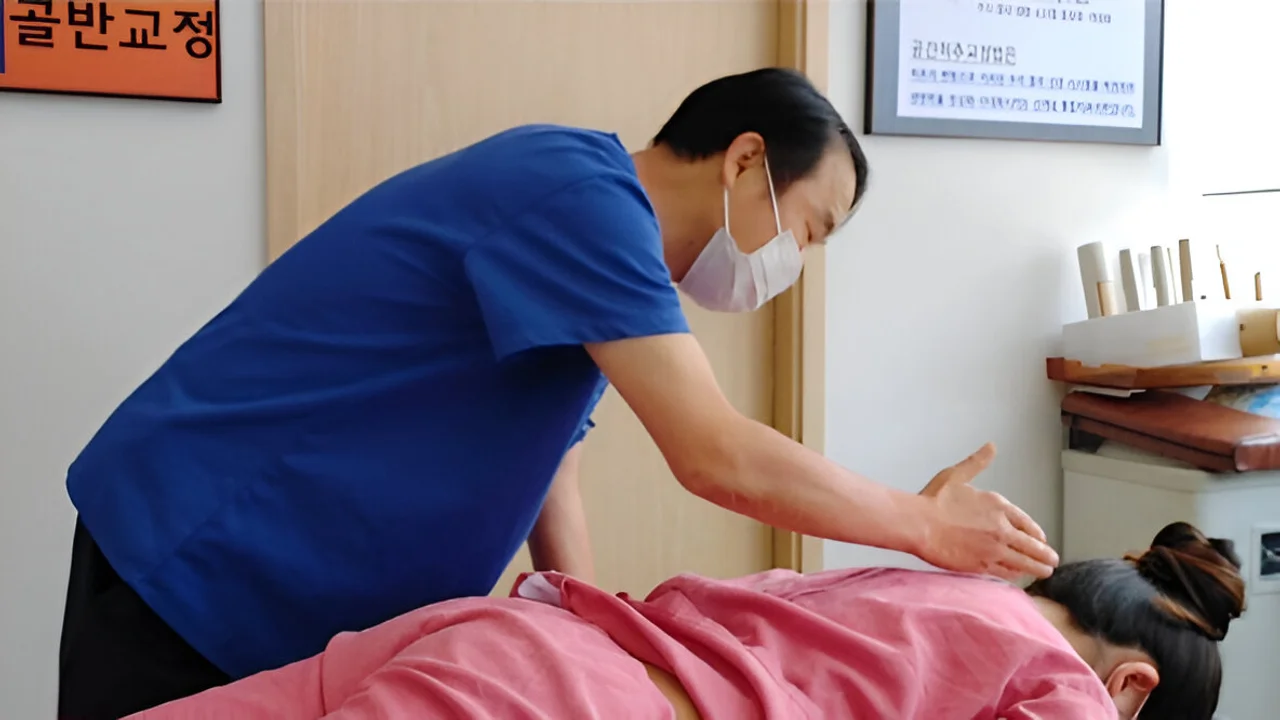
At Banpo Newborn Oriental Medical Clinic, Dr. Ungjin Im leads a conservative, precision-focused approach that’s helped many patients defer or avoid surgery for Spinal Stenosis, particularly Lumbar Spinal Stenosis. Our method integrates several service names central to our practice:
1) Spinal Alignment Restoration Therapy (SART)
Our signature SART protocol emphasizes spatial realignment—the three-dimensional correction of pelvic, lumbar, and thoracic segments. By improving segmental mechanics and distributing load more evenly, patients often experience reduced compression and better walking tolerance.
2) Spatial Spinal Correction & Chuna Therapy
Using gentle, hands-on Chuna therapy, we guide restricted joints and soft tissues toward balance. This is not forceful manipulation. Instead, it’s a calibrated, patient-specific method designed to reduce guarding patterns linked to Dystonia, neck stiffness, and back pain while improving gliding of the facet joints that can be irritated in stenosis.
3) TMJ & Cervicothoracic Integration
Because jaw and upper cervical mechanics influence posture, we screen and, when indicated, treat Temporomandibular Joint (TMJ) dysfunction. Addressing TMJ Disorder/TMJ Syndrome can reduce head-forward posture and secondary Headache, occasionally easing Tinnitus related to myofascial tension.
4) Targeted Rehabilitation & Gait Training
More Medical Articles
Continue reading clinical insights from Banpo Newborn Korean Medicine Clinic.

Why Seoul is the Global Hub for Minimally Invasive Vertigo Treatment
Dizziness and vertigo are among the most common reasons for hospital visits in South Korea, affecting nearly 16.7% of the adult population annually according to the Korea National Health and Nutrition Examination Survey (KNHANES).
Learn More

Tinnitus Relief in Seoul: Multidisciplinary Upper Cervical Care
For many, the sound of silence is replaced by a persistent ringing, buzzing, or hissing. In South Korea, this is more than an individual annoyance; it is a significant public health trend.
Learn More

Success Rates of SART for OPLL Compared to Standard Laminectomy in Korea
The prevalence of Ossification of the Posterior Longitudinal Ligament (OPLL) in East Asian populations, particularly in South Korea, is significantly higher than in Western countries, affecting approximately 2% to 4% of the population according to nationwide...
Learn More