SART Whole-Body Spinal Alignment, Chuna Therapy & International Patient Concierge
30+ Years Clinical Experience
en-US


Korean Medicine Guide
Real Patients, Real Results: Treating Wry Neck with Korean Medicine
Discover real patient stories of wry neck treatment with Korean medicine. Learn how holistic care restores balance, mobility, and lasting relief.
Schedule a Consultation
If your head keeps tilting to one side, your neck feels locked, and simple turns trigger sharp pain, you may be dealing with Wry Neck—often called Torticollis. It can start overnight or build slowly after long hours at a desk. Either way, it’s frightening when your neck won’t cooperate. To be honest, many people are told to “wait it out” or rely on painkillers. At Banpo Newborn Oriental Medical Clinic in Banpo, Seoul, we take a different path: a gentle, non-surgical program that treats the neck, shoulder, jaw, rib cage, and pelvis together—so results last.
Below, you’ll see how Dr. Ungjin Im and our team help real patients unwind Wry Neck patterns using Spinal Alignment Restoration Therapy (SART), spatial spinal correction, Chuna manual therapy, acupuncture, targeted herbal support, and tiny-but-mighty home drills. You’ll also learn how conditions like TMJ Disorder, Scoliosis, Disc Herniation/Herniated Disc/Slipped Disc, and Lumbar Spinal Stenosis can quietly feed neck stiffness—and what we do about it.
What is Wry Neck (Torticollis) — and why does it happen?
Wry Neck / Torticollis describes a persistent tilt and/or rotation of the head and neck, often with spasm and Neck pain, Neck stiffness, or Neck ache. Common triggers and contributors we see:
Protective spasm after a neck strain or awkward sleep position
Postural overload (forward head, rounded upper back, shrugged shoulders)
TMJ overload from clenching or grinding (think Temporomandibular Joint (TMJ), TMJ Syndrome, TMJ Disorder)
Rib cage stiffness that forces the neck to “hold you up”
Lower-body drivers: pelvic tilt, hip pain, Pelvic pain/Pelvic discomfort, Lower back pain/Lumbar pain, or Backache that migrate strain up the chain
Irritated discs or nerves (cervical or lumbar), mild Scoliosis, and Dystonia/Muscle Dystonia-like holding patterns that keep one side “on”
Stress and poor sleep, which keep muscles guarded and reactive
Left alone, Wry Neck tends to recruit nearby regions: Shoulder pain, Shoulder stiffness, even Frozen shoulder; Headache/Chronic Headache; and in some people Tinnitus from upper-cervical and TMJ tension.
Why Korean medicine works well for Wry Neck
Our method blends traditional Korean medicine with modern biomechanics. Instead of chasing one tight muscle, we restore the sequence—pelvis → rib cage → cervical spine → jaw—so your neck no longer works alone.
What we use (non-surgical):
Spinal Alignment Restoration Therapy (SART) — gentle, precise corrections to create space at irritated segments and calm guarding
Spatial spinal correction — three-dimensional re-centering (tilt, shift, rotation) so changes hold
Chuna manual therapy — restores joint play and soft-tissue glide without aggressive thrusts
Acupuncture, moxibustion, cupping — reduce inflammation, ease spasm, improve microcirculation
Personalized herbal support — simple formulas when appropriate
Neuromuscular re-training — 2–3 micro-drills (minutes total) that reinforce new alignment in daily life
“To be honest, the body wants balance. Our job is to remove the barriers—compression, poor load-sharing, and protective guarding—so comfort can return.” — Dr. Ungjin Im
Real patients, real results
Case 1: Overnight Wry Neck after a stressful week
Hana, 32, woke unable to turn left, with Neck pain radiating into the temple and morning Headache. She clenched her jaw during deadlines (TMJ Disorder), and her right shoulder rode up while working.
Findings: Forward head, tight suboccipitals, jaw deviation on opening, limited rib mobility.
Plan: SART (C0–C3), Chuna for upper thoracic/rib glide, targeted TMJ release, two drills (suboccipital-breathing + scapular setting).
Result: At 2 weeks her turning range doubled with fewer headaches; at 6 weeks, head sat midline and workdays no longer provoked spasm.
Case 2: Wry Neck plus shoulder freeze after a back flare
Mr. Lee, 57, had a history of Herniated Disc and recurring Lower back pain. He developed right head tilt and Frozen shoulder on the same side.
Findings: Pelvic rotation with short stride, rib cage bracing, upper-cervical overload.
Plan: Decompression-biased SART through pelvis→thorax→neck, spatial correction to re-stack the rib cage, Chuna for scapular glide, short walk intervals, hip-hinge retraining.
Result: At 4 weeks, shoulder elevation decreased and neck centered more easily; at 8 weeks he could check blind spots while driving without pain.
Case 3: Torticollis with tinnitus reactivity
Eun-woo, 44, had left head tilt, Tinnitus that spiked with head turn, and evening Neck stiffness.
Findings: Upper-cervical joint congestion, jaw clenching, limited rib rotation; desk setup below eye level.
Plan: SART (upper cervical), TMJ harmonization, Chuna for rib mobility, acupuncture, ergonomic fixes, two drills (jaw relaxer + open-book rotation).
Result: Within 3 visits, fewer tinnitus spikes with head turns; at 6 weeks, tilt reduced and mornings felt “quiet” with easier rotation.
Results vary; the key is matching the treatment to the true driver, not just stretching what hurts.
Our step-by-step program for Wry Neck
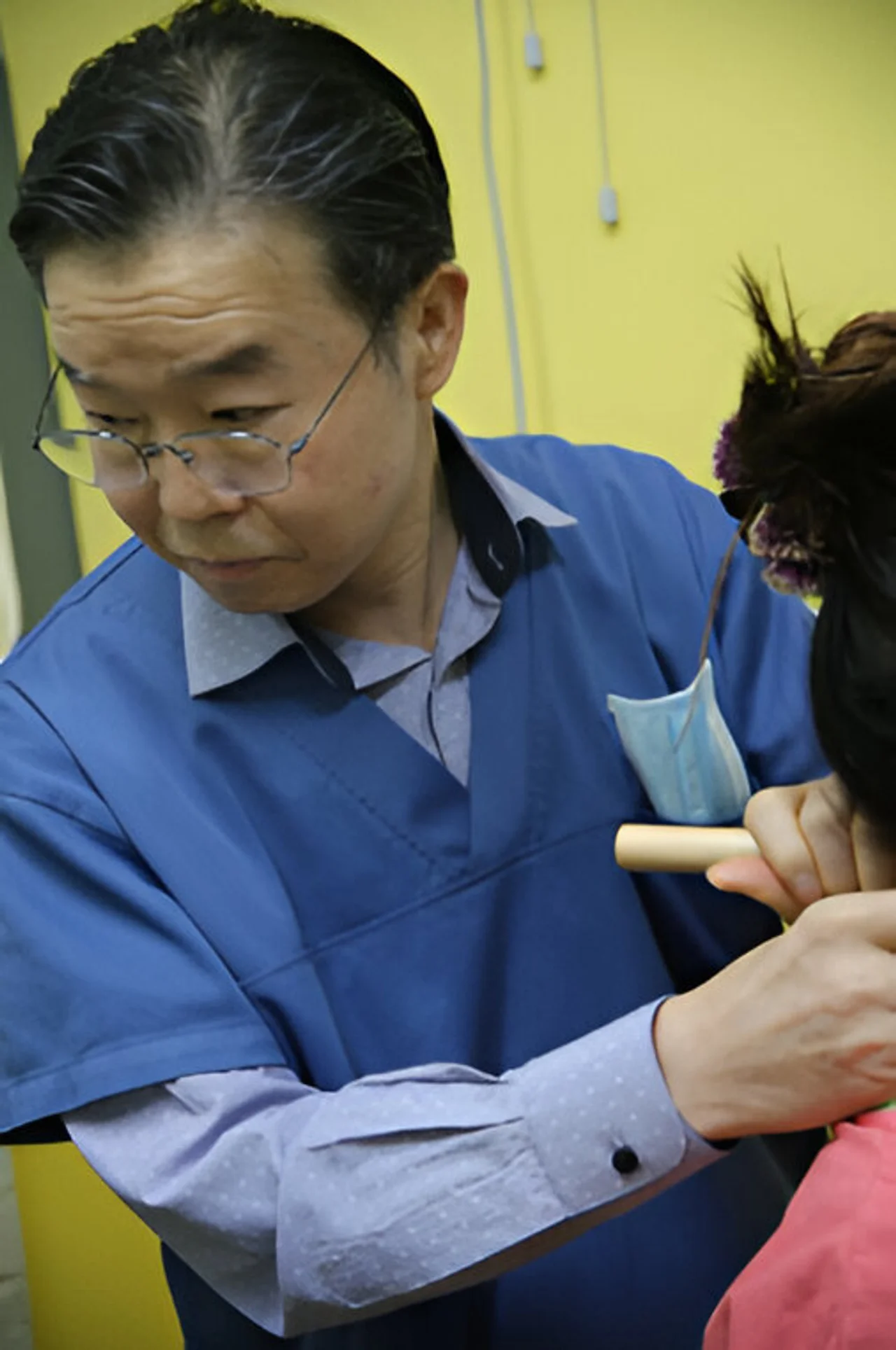
1) Root-cause evaluation
We map your whole pattern: neck segments, scapular motion, rib mobility, pelvis orientation, stride, and TMJ mechanics. We also screen for contributors like Scoliosis, Torticollis, Wry Neck history, and Dystonia/Muscle Dystonia-like tendencies. Bring imaging if you have it—cervical or lumbar (Disc Herniation, Slipped Disc, Spinal Stenosis/Lumbar Spinal Stenosis)—we interpret scans in the context of movement.
2) Gentle, precise care
SART to decompress and center the neck and rib cage
Spatial spinal correction to restore symmetry in three planes
Chuna to free the upper thoracic facets and scapulothoracic glide
Acupuncture to settle spasm; moxibustion/cupping as indicated
TMJ soft-tissue and joint decompression when jaw tension fuels tilt
3) Tiny home drills
Two or three micro-drills (minutes total):
Suboccipital decompression breathing (60–90 sec) — lengthen the back of the neck while expanding lower ribs
Scapular setting — upward rotation/posterior tilt without shrugging
Log-roll sleep setup — side-lying with shoulder-height pillow; pillows between knees and ankles to level the pelvis
Optional: jaw relaxer — tongue to palate, teeth apart, slow exhale
4) Track progress with simple, objective markers
Head center at rest (mirror check)
Comfortable rotation degrees (L/R)
Morning stiffness score (0–10)
“Shirt test” or seatbelt reach ease
Headache/tinnitus episodes per week (if present)
Why your lower body can lock your neck
Many Wry Neck cases persist because the pelvis and rib cage are misaligned. A rotated pelvis or hip pain changes gait; the rib cage stiffens to “protect” a sensitive Lumbar spine (after Back pain, Lower back pain, Lumbar pain, Herniated Disc, or Lumbar Spinal Stenosis). The head migrates forward and sideways; the neck tightens to keep you upright. Because our clinic also specializes in How Banpo Newborn Oriental Medical Clinic Treats Spinal Stenosis Without Surgery, we’re experienced at restoring decompression and gait—freeing the neck by fixing what’s below it.
At-home strategies that calm Wry Neck
Raise the screens. Top of monitor at eye level; bring the phone up to your face, not your face down to the phone.
Micro-breaks every 30–45 minutes. Stand, exhale softly, lengthen the back of your neck, roll shoulders down and around (not up and back).
Sleep neutral. Side-lying with a shoulder-height pillow; put pillows between knees and ankles to keep the pelvis level. Avoid stomach sleeping.
Heat then move. 10 minutes of gentle heat over upper back/neck before easy mobility—not aggressive stretching into pain.
Walk smart. Short, relaxed walks (8–12 minutes) free the rib cage and calm the nervous system.
If any self-care worsens pain, causes numbness, or triggers severe Headache, pause and let us tailor a gentler progression.
When to seek urgent evaluation
Most Wry Neck improves with conservative care, but seek immediate medical attention if you have:
Sudden severe weakness, numbness, or loss of coordination in the arm/hand
High fever, significant trauma, or unexplained weight loss
Progressive neurological signs or severe night pain
Red-flag symptoms after an accident
Your safety comes first. If surgical or medical care is the smarter path, we’ll explain why and coordinate referrals promptly.
Frequently asked questions
Will you “crack” my neck?
Our default is gentle. SART and spatial spinal correction rely on precise, guided releases. Some Chuna techniques create joint play without aggressive thrusts.
How many sessions will I need?
It depends on duration and complexity. Many patients notice early changes—easier head-centering, smoother rotation—within the first few visits. We set clear markers so you can see progress.
Can Wry Neck cause headaches or tinnitus?
Yes. Upper-cervical and TMJ tension often fuel Headache/Chronic Headache and Tinnitus. Treating the neck, jaw, and rib cage together usually reduces flare frequency.
More Medical Articles
Continue reading clinical insights from Banpo Newborn Korean Medicine Clinic.

Why Seoul is the Global Hub for Minimally Invasive Vertigo Treatment
Dizziness and vertigo are among the most common reasons for hospital visits in South Korea, affecting nearly 16.7% of the adult population annually according to the Korea National Health and Nutrition Examination Survey (KNHANES).
Learn More

Tinnitus Relief in Seoul: Multidisciplinary Upper Cervical Care
For many, the sound of silence is replaced by a persistent ringing, buzzing, or hissing. In South Korea, this is more than an individual annoyance; it is a significant public health trend.
Learn More

Success Rates of SART for OPLL Compared to Standard Laminectomy in Korea
The prevalence of Ossification of the Posterior Longitudinal Ligament (OPLL) in East Asian populations, particularly in South Korea, is significantly higher than in Western countries, affecting approximately 2% to 4% of the population according to nationwide...
Learn More