SART Whole-Body Spinal Alignment, Chuna Therapy & International Patient Concierge
30+ Years Clinical Experience
en-US


Korean Medicine Guide
Still Suffering from Tinnitus? Let’s Build Your Personalized Relief Plan
Personalized tinnitus relief plans that target root causes. Learn proven treatments, lifestyle tips, and expert strategies to finally ease ringing ears.
Schedule a ConsultationStill Suffering from Tinnitus? Let’s Build Your Personalized Relief Plan

By Banpo Newborn Korean Medicine Clinic
Have you ever noticed how tinnitus seems to grow louder at the worst possible times—late at night, in moments of stress, or right after a long day of sitting in front of a computer? Many of the patients who visit our clinic describe the same experience: “It’s not just the ringing. It’s the feeling of being trapped by something I can’t escape.”
If you’ve been living with tinnitus—whether it feels like ringing, buzzing, whooshing, or a constant tonal hum—know this: you are not imagining it, and you are not alone. Tinnitus is real, it is often physically rooted rather than “all in your head,” and most importantly, there are ways to reduce it when you understand where it’s coming from.
At Banpo Newborn Korean Medicine Clinic, we’ve spent decades helping patients uncover the hidden structural and neurological factors behind their tinnitus. Many are surprised to learn that the source often lies not in the ear itself, but in the neck, jaw, and spine—areas that silently influence the auditory system far more than most people realize.
This article will guide you step-by-step through how tinnitus develops, why it persists, and how we build a personalized, holistic relief plan to finally help you reclaim your quiet.
What Most People Don’t Realize About Tinnitus
To be honest, one of the biggest misunderstandings we see is the belief that tinnitus is simply an “ear problem.” While ear-related causes certainly exist, chronic tinnitus often stems from a breakdown in the body’s structural and neurological balance—a system in which the cervical spine, jaw joint (TMJ), and autonomic nervous system play major roles.
Patients frequently come to us saying:
“My ENT said my hearing is fine… so why do I still hear this noise?”
“The ringing gets worse when my neck is stiff.”
“I noticed my jaw clicks—and the sound changes when I move it.”
These clues tell us that tinnitus is rarely a single-source issue. Instead, it is often the consequence of musculoskeletal tension, nerve irritation, and circulatory imbalance—all of which can be corrected when we restore proper spinal and TMJ alignment.
The Hidden Links: Spine, TMJ, and Tinnitus
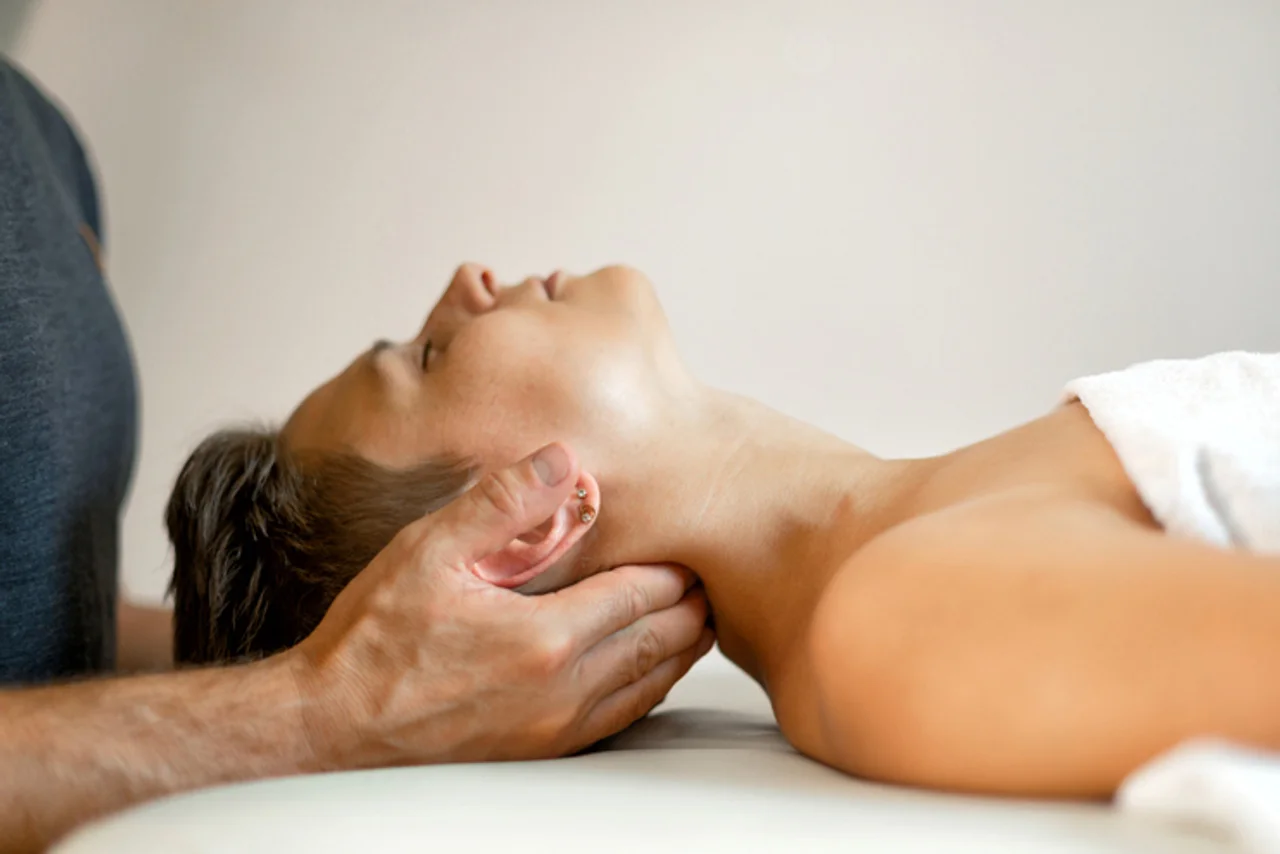
1. The Cervical Spine and Auditory Nerves
Your cervical spine houses nerves and blood vessels that interact closely with the auditory system. When the upper neck is misaligned—often from poor posture, long hours at a desk, past injuries, or digital-device habits—it can:
Irritate the trigeminal and upper cervical nerves
Restrict blood flow to the inner ear
Increase muscle tension around the skull base
This combination can trigger or worsen tinnitus.
A patient once told us, “When my neck is tight, the ringing feels like it’s pulsing.” After realigning her cervical spine through our Spatial Spinal Correction approach, the pulsing frequency gradually diminished.
2. TMJ Dysfunction and Ear Pressure
The jaw joint sits remarkably close to the ear canal. When the TMJ is misaligned or overworked (from clenching, grinding, or stress), it can create:
Pressure changes that affect the eardrum
Nerve compression that influences auditory processing
Referred tension into the neck and temporal muscles
Many tinnitus sufferers have never been evaluated for TMJ imbalance, even though it’s one of the most common contributing factors.
3. Autonomic Nervous System Overload
Stress doesn’t just make tinnitus more noticeable—it can intensify it. Chronic tension in the neck and jaw sends constant distress signals to the nervous system, pushing it into a state of heightened alertness. In this mode, internal sounds like tinnitus become amplified.
This is why building a relief plan isn’t only about correcting structure—it’s also about guiding the body back to ease.
Why Tinnitus Persists: A Korean Medicine Perspective
In Korean medicine, tinnitus is often interpreted as a sign of imbalanced circulation and disrupted energy pathways, especially those associated with the kidney, liver, and gallbladder meridians. But our clinic bridges this traditional understanding with modern musculoskeletal science.
We often explain it this way to patients:
If the spine is the foundation of a house, tinnitus is like the creaking sound you hear when the foundation is slightly off. Fix the foundation, and the creaking often settles.
In other words, the sound itself is not the core problem—it’s a signal pointing to deeper structural and neurological patterns.
Our Philosophy: Tinnitus Care Must Be Personalized
Over the past 30 years, we’ve met thousands of tinnitus patients. Some describe a faint ringing; others feel overwhelmed by a constant electrical buzz. Some notice symptoms only when stressed; others experience them around the clock.
Because of this variety, there is no single “treatment” for tinnitus that works for everyone.
This is why our clinic never offers generic tinnitus protocols. Instead, we build a personalized relief plan based on:
Your unique symptom pattern
Your spinal alignment
Your TMJ function
Your stress levels
Your daily habits and posture
Your neurological response
A truly effective plan must address the whole human being—not just one organ or one symptom.
How Banpo Newborn Builds Your Personalized Tinnitus Relief Plan
Step 1: Comprehensive Diagnostic Evaluation
We begin with a detailed, one-on-one assessment that includes:
Cervical spine alignment analysis
TMJ mobility and muscle tension testing
Postural assessment (head-forward posture is a common trigger)
Pulse and abdominal diagnosis from Korean medicine
Lifestyle, sleep, and stress evaluation
Patients often tell us this is the first time anyone has examined their tinnitus holistically—not just through a hearing test.
Step 2: Spinal Alignment Restoration Therapy (SART)
Developed through decades of clinical experience, SART is a gentle, highly precise method for restoring proper spinal structure without forceful manipulation.
For tinnitus patients, SART focuses especially on:
C1–C3 alignment
Restoring space around the upper cervical nerves
Releasing deep suboccipital tension
When the neck returns to its natural alignment, the nervous system becomes calmer, circulation improves, and tinnitus symptoms often decrease in intensity.
Step 3: Spatial Spinal Correction for Neurological Balance
Unlike conventional adjustments, spatial correction addresses how the spine interacts with gravity. Many tinnitus patients have subtle rotational imbalances that affect blood flow and nerve function.
Correcting these allows the auditory system to “decompress,” creating measurable relief.
Step 4: TMJ Realignment & Chuna Therapy
If TMJ dysfunction is contributing to your tinnitus, we incorporate:
Jaw joint decompression techniques
Myofascial release of the temporal and masseter muscles
Chuna therapy to rebalance the cranial and cervical structures
A memorable case involved a patient whose tinnitus vanished only after decompressing her TMJ—something years of medication had never addressed.
Step 5: Nervous System Reset & Stress Regulation
Tinnitus grows louder when the nervous system is overwhelmed. So we integrate traditional Korean medicine techniques such as:
Acupuncture targeting auditory and stress-regulating pathways
Herbal medicine to support circulation and calm the mind
Breathing and posture retraining
Many patients report that not only does the tinnitus soften, but their sleep and concentration improve as well.
Step 6: Home-Care Training & Long-Term Prevention
Healing does not end when you leave the clinic. We teach patients:
How to maintain neck alignment
Jaw relaxation techniques for clenching
Daily micro-stretches to prevent muscle buildup
Sleep posture adjustments
Digital-habit modifications to reduce cervical tension
Tinnitus relief becomes sustainable when your daily life supports your structural health.
Real Patient Story (Shared with permission)
One of our patients, a 42-year-old office worker, came to us after enduring tinnitus for five years. He described it as “a sharp whine that never turns off.” After multiple hospital visits and medication trials, he felt discouraged.
During his evaluation, we discovered:
Severe forward-head posture
Tightness in the upper cervical muscles
TMJ deviation
High stress levels
Within three sessions of SART and TMJ-focused Chuna therapy, he reported that the pitch had softened. After six weeks, he could sleep without masking noise for the first time in years.
He told us, “This is the first time I feel like my body and my tinnitus are connected—and finally improving.”
Stories like his are what our clinic is built on.
Why Personalized Treatment Works Better Than One-Size-Fits-All Approaches

Many tinnitus sufferers try:
Ear drops
Supplements
White-noise machines
Stress-reduction apps
Medication
These can help temporarily, but they don’t address the underlying alignment and neurological causes.
Your tinnitus pattern is as unique as your fingerprint—how it responds to posture, stress, jaw movement, or sleep tells us precisely what your body needs.
A personalized plan takes into account:
Your structural asymmetries
Your lifestyle
Your stress patterns
Your nervous system sensitivity
Your long-term health goals
This is why our patients often say, “My tinnitus finally makes sense now.”
If You’re Still Suffering, Here’s What You Can Do Today
1. Check Your Posture
More Medical Articles
Continue reading clinical insights from Banpo Newborn Korean Medicine Clinic.

Why Seoul is the Global Hub for Minimally Invasive Vertigo Treatment
Dizziness and vertigo are among the most common reasons for hospital visits in South Korea, affecting nearly 16.7% of the adult population annually according to the Korea National Health and Nutrition Examination Survey (KNHANES).
Learn More

Tinnitus Relief in Seoul: Multidisciplinary Upper Cervical Care
For many, the sound of silence is replaced by a persistent ringing, buzzing, or hissing. In South Korea, this is more than an individual annoyance; it is a significant public health trend.
Learn More

Success Rates of SART for OPLL Compared to Standard Laminectomy in Korea
The prevalence of Ossification of the Posterior Longitudinal Ligament (OPLL) in East Asian populations, particularly in South Korea, is significantly higher than in Western countries, affecting approximately 2% to 4% of the population according to nationwide...
Learn More